
These stories can also be heard on Sunday mornings around 10 am on WILD 102’s “Look Back in Time” program. Each week’s radio story will be posted here on our website.
Weekly radio stories are researched, compiled, and read by Sheila Winstead, RCHS Board Member.
February 22, 2026
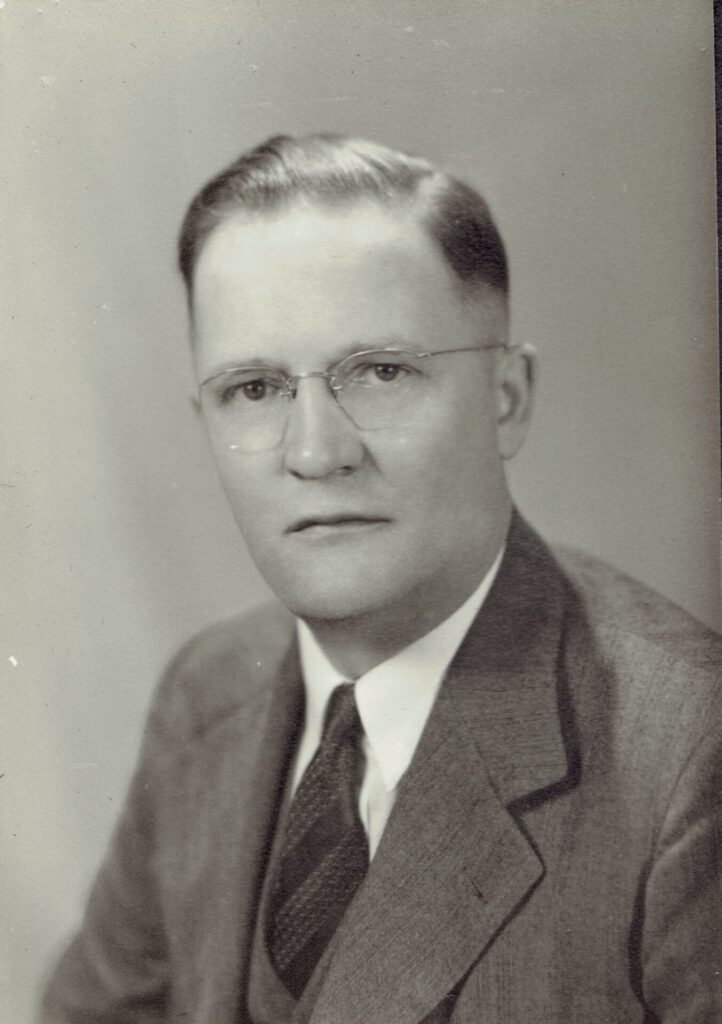 Today I’ll finish reading the story written by C Arthur Johnson about the arrival of his grandfather, Mikkel Johnson, to what is now Roseau County. He had started out from Wilhelmina, Sweden in 1886, arriving in Minnesota, and moving north with his wife and youngest five children into what was still Kittson County in 1890, which was becoming more populated with other settlers. Here he lived just east of Roseau. I’ll continue with his story now.
Mikkel Johnson and family found they had other neighbors that were more nomadic than the people from Norway and Sweden. They were the original settlers, the Indians. You see, the Indian Trail lead right through his land, through Church Nelson’s land, west to what is now Roseau; east it angled toward what is now Warroad. One memorable evening, an Indian chief named Mickinock stopped with his family. By way of introducing himself he opened the door of the cabin slightly and thrust in a large fish. The startled family somehow realized that it was a peaceful gesture and opened the door. After a session of grunts and sighs, the fish was accepted as a gift for the privilege of staying indoors overnight. It was cold outside! His family consisted of several wives and numerous children. The first floor was given over to the Indians,
who changed the moss packing on the babies and leaned the cradleboards against the wall.
Laundry was no problem. The others made themselves comfortable in the warm room and slept soundly, unaware of the wide eyes peering through the cracks in the loft floor.
The Indians in this area were friendly. In spite of this in 1891, there was an Indian scare. It
seems that their annual Pow Wow and dances were misunderstood. Many settlers, afraid for
their scalps, left unceremoniously. The bewildered Indians watered and fed the deserted stock
until word caught up with the fugitives that all was peaceful. Church Nelson, in his genial way,
chuckled, “We might have gone too if we’d had a way to go!”
As time went on additions to the cabin and barns were built, and some land clearing was done
by ox-power and human muscle, with many a backache thrown in. Along with other settlers they
found that there were some drawbacks in their new land, such as bull flies and mosquitoes, and
much water in summer, and deep snow in winter. But their faith in God, in themselves, and in
the future far outweighed these negative things. What was to them the County of Pea-vines, the
natural legume, has developed into the County of Clovers for us. The immigrants from Sweden,
Norway and elsewhere that struggled through those early days have some time ago laid down
their tools, which consisted mainly of grub hoe, pick ax, axe, saw, scythe and 2-ox walking plow,
are now resting beneath the very sod they wrested from the wilderness. In due respect to them
may we realize that without the raw materials their faith and toil produced, there would be no
commerce, no cities, no towns, no progress.
In course of time, Mikkel Johnson, my grandfather, felt that his farming days were over, so in
1905 a transaction was made by which one of his sons, Nils Oscar, my father, took over the
farm. The endless grubbing and clearing went on. As small patches were cleared by dint of hard
work, the horse-drawn walking plow broke the virgin soil and fields were seeded. Eventually
these patches merged into larger fields, and so a farm was carved out.
Life may have been rugged but it was not uneventful. How could it be with 4 boys and 4 girls
growing up? One tot went for a stroll down the Indian Trail one day and became lost. When the
frightened parents found her, and asked what she would have done if she’d seen a wolf – a
thing they had feared—she replied undaunted, “I’d just say ‘Woof!’ and he’d run away.” A wolf
did drink from the stock trough at times and other wild animals were seen occasionally.
The oaks bordering the Indian Trail suggested the name my parents chose for this farm, “Oak
Lane”. The Trail has been abandoned since about 1910, but many of the trail-marking trees still
stand.
After some 41 years of homemaking on this farm, my mother passed away, and shortly after
that my father retired from farming. In 1943 we purchased the farm and have lived here since.
The fourth generation of children, now getting pretty well grown, has enjoyed the freedom of
country life, though the woods with its glamour has disappeared. Such is progress! Or is it?
Thank you to  for letting us share our county’s history with your listeners by donating air time, studio time, and production staff every week.