
Visit the Roseau County Historical Society and Museum and take in our current exhibits.
Lightning Pants
Lightning Pants
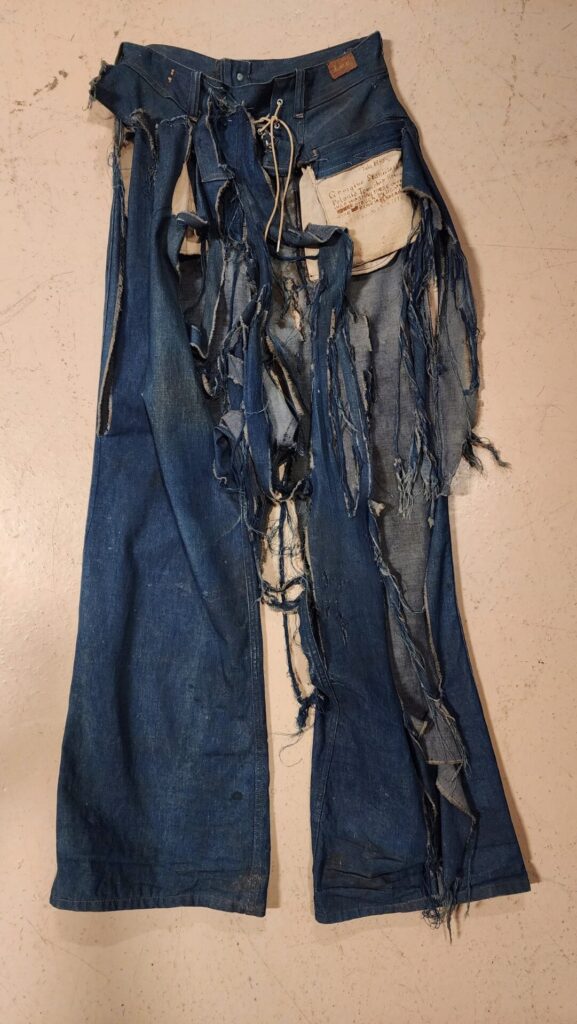
Struck by History: The Incredible Story of the Lightning Pants
A lightning strike, a pair of shredded overalls, and one very lucky 11-year-old girl. Lightning Shreds Girl poster
On a Saturday afternoon in August 1945, 11-year-old Georgine Stanislawski of Polonia Township, Roseau County, experienced something few people could imagine. A bolt of lightning struck her family’s farmhouse, leaving her with injuries, a remarkable story of survival, and a pair of overalls that would eventually become one of the Roseau County Museum’s most unusual artifacts.
A Sweet Treat and an Unexpected Storm
Earlier that day, Georgine had been to town, where she picked up some candy to bring home. Later that afternoon, as a thunderstorm moved through the area, the Stanislawski family gathered in the kitchen of their farmhouse.
Georgine reached for the candy near the kitchen countertop. According to the story passed down, the metal button on her new denim overalls was touching the metal edging of the countertop at the very moment lightning struck the house.
The electrical current traveled through the house, and Georgine was thrown across the room.
The force of the strike tore through her overalls, shredding the denim into long, ragged strips. The newspaper later described the clothing as looking like “ragged ribbons.”
A Remarkable Escape
Despite the frightening experience, Georgine survived.
According to the Roseau Times-Region, she suffered painful burns around her hips, groin, and legs, but her injuries were not considered serious. Her eight-year-old sister, Alice, was not directly struck but received a severe shock.
The lightning also damaged kitchen utensils and parts of the farmhouse. Remarkably, the house did not catch fire.
One particularly unusual detail reported in the newspaper was that a pocket from Georgine’s overalls had been torn completely off and thrown onto the kitchen table.
Her father, Alex Stanislawski, recalled picking up Georgine after she had been knocked down and being relieved to discover that she was alive.
The Pants That Survived
Although Georgine recovered, her overalls were never the same.
The shredded denim was preserved, providing a striking reminder of just how powerful lightning can be. Today, the overalls—better known as the Lightning Pants—are part of the Roseau County Museum’s collection.
Visitors can see the extensive damage for themselves, from the torn fabric to the long strips of denim left hanging after the strike.
It is an artifact that often stops visitors in their tracks and leaves them asking, “What happened to those pants?”
See the Lightning Pants for Yourself
Some of the most memorable stories in Roseau County history are found in everyday objects. In this case, a simple pair of denim overalls tells an extraordinary story of survival.
The Lightning Pants are among the unusual artifacts on display at the Roseau County Museum in Roseau, Minnesota.
Come see the pants that were struck by history!
Historical source: Roseau Times-Region, August 16, 1945. Additional details from the story associated with the artifact.
Roseau Runestone
Roseau Runestone
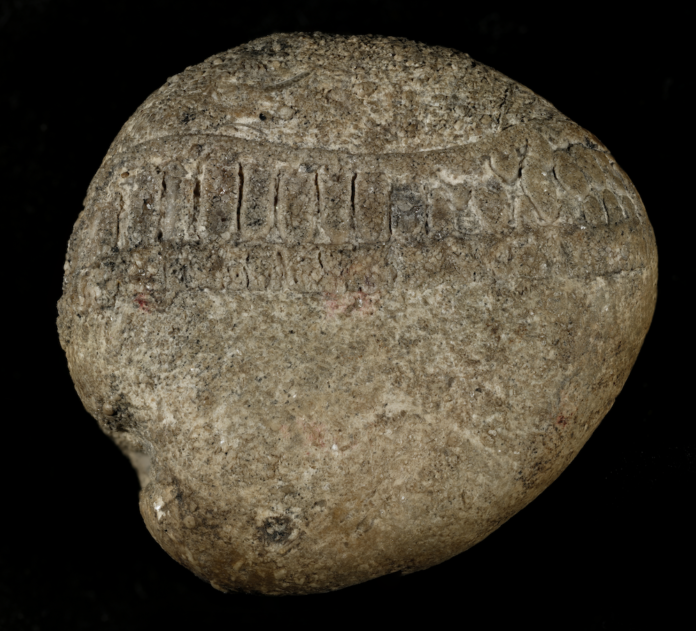
The Roseau Runestone: A Little Piece of History & Mystery
Sometimes the smallest objects hold the biggest mysteries.
The Roseau Runestone is one of the most unusual artifacts on display at the Roseau County Museum. Roughly the size of a golf ball, this small stone features a distinctive band of markings that has sparked curiosity and conversation.
What makes the stone so intriguing? Its unusual appearance, its history, and the questions surrounding its markings have made it a memorable part of the museum’s collection.
Visitors are invited to take a closer look, consider the mysteries of the past, and discover why this little stone continues to capture attention.
Small stone. Big mystery.
See the Roseau Runestone for yourself at the Roseau County Museum in Roseau, Minnesota.
Lake Agassiz
Land Development of Roseau County – Lake Agassiz & Roseau Lake

Lake Agassiz (/ˈæɡəsi/ AG-ə-see) was a large proglacial lake that existed in central North America during the late Pleistocene, fed by meltwater from the retreating Laurentide Ice Sheet at the end of the last glacial period. At its peak, the lake’s area was larger than all of the modern Great Lakes combined. It eventually drained into what is now Hudson Bay, leaving behind Lake Winnipeg, Lake Winnipegosis, Lake Manitoba, and Lake of the Woods. Wikipedia.com.
This exhibit shows the glacier melt and the formation of beaches left from the shores of Lake Agassiz. It also tells about the history of Roseau Lake and the dredging to drain the lake bottom. Along with the informational posters is a sampling of fossils from the county and beyond.
Native American History
Native American History

The Native American exhibit displays artifacts from the Roseau County Native American community or the area. The Ross Indian Village photo sets the backdrop for the exhibit. History covers Chief KaKayGeesik, Mickinock, NaMayPoke, and an Ojibwe jingle dress.
“In one of the final battles between the Sioux and the Ojibwa at Two Rivers, some 40 miles west of Warroad on the War Trail, AyAsh-A-Wash was badly wounded and played dead. As he lay there, he was scalped by a Sioux Warrior.
Ay-Ash-A-Wash, still alive, managed to crawl away and hide for a time. Most thought he was lost in battle, but he returned to Warroad after a few days.
There was a great outpouring of joy when he returned to Warroad badly injured, but still alive. Years later Ay-Ash-A-Wash’s son Na-May-Poke, who was thought to be the Chief of Warroad, was a wise man who cherished education.
Na-May-Poke decided to sell part of his land allotment on the Warroad River for the first Warroad School. He agreed to sell the land at a very cheap price and asked that the name Warriors be instilled for athletic competition.
This would be used to show honor to those whose blood was left on the sacred land and to those who fell in battle. His request was honored and the teams would be carrying the name Warriors with pride.” Warroad Public School
Immigration
Immigration to Roseau County

We have created exhibits showcasing the immigration of Roseau County pioneers.
Transportation
Transportation in Roseau County

Check out all the transportation methods used across Roseau County through the Medora Stagecoach, railroad, cars, oxen cart, and more.
The railroad was a significant part of the formation or fall of towns in Roseau County.
“The original setting of the city was on a ridge of what used to be the shores of ancient Lake Agassiz. This village is now referred to as “Old Greenbush”. Old Greenbush began in 1898 when Olaf Hildahl built a general store approximately two miles northeast of the present city. Shortly thereafter, T.T Lanegraff and son moved their agricultural tools and equipment business from their farm to the ridge. By 1904, the Lear Brothers’ farm implements and blacksmithing, Chilstrom’s Hotel and Livery, Farmer’s and Merchant’s State Bank, Mike Johnson’s Grocery, and Sander’s Greenbush Journal had followed. Thorpe’s sawmill was located near the little town. And we mustn’t forget Mr. Nixon’s business, a “blind pig”, to use a colorful expression of the time. Mr. Nixon was a bootlegger. Old Greenbush was developing rapidly.
In 1904, the great railroad came to the area. It expanded north from Thief River Falls to where present day Greenbush is, where it stopped construction. Being the progressive village that it was, Greenbush merchants moved their businesses, buildings and all, to the new town known as “West Greenbush”. All that remains of the old town today is Hvidso Cemetery along Highway 11, more commonly referred to by the locals as Pioneer Haven.
New Greenbush grew quickly and incorporated in 1905. Before long, there were three hardware stores, a print shop, three banks, livery stables, two blacksmith shops, a general store, four small restaurants, four beer parlors, a lumber yard, a large creamery, four implement dealers, three new car dealerships, thirteen businesses with gas pumps, a shoemaker, three wool buyers, three cream stations, four grass seed buyers, five or six grocery stores, two barber shops, two fur and hide buyers, and a hotel. All of these businesses with a population of 450 people.
Just three or four years later the rail line to Warroad was completed and it ran right through the site of Old Greenbush.” City of Greenbush’s website
Delmore Clinic
Delmore Clinic

Learn about the legacy of the Delmore family and Marie Budd some of the medical pioneers in Roseau County.
Agriculture
Agriculture & Dairy in Roseau County

Agriculture is one of the primary sources of income in Roseau County from the beginning. The dairy industry was a major family industry that helped create the county.
“Dairy has been a sustained power in maintaining the economy of this area. The early farmers could not have existed without it. Diversity was a necessary order of the day. Now it is more or less a matter of putting all our eggs in one basket, not only in farming but in merchandising as well. Gone are the general merchandising stores who would barter for anything the farmer had to offer, and in turn, handled every type of merchandise, from dry lutefisk and grub hoes to corsets. In reality, it was a butter and eggs way of doing business. Butter was churned in the home, put into crocks or shaped with a butter mold, usually round with an interesting design on the top, and delivered to the merchants in a trade or to private customers. The increase in farms and the growing number of dairy cattle soon produced more butter than the merchants could dispose of. It was time to build a creamery, and that is just what the farmers organized and did. The North Star Creamery, built-in 1902, on Badger Creek banks, as shown on accompanying pictures, continued operating there until 1924, when a large modern plant was built. This latter building still stands but is no longer a creamery. It ceased operating on May 1, 1971, a casualty of changing times.” Pioneers and Progress Badger, Minnesota, 1906-1981
P.O. Fryklund
Per Olaf Fryklund


Per Olaf Frylund was one of the founders of the Roseau County Historical Society. The historical society bought his collection to create the Roseau County Museum. Fryklund’s collection can be seen throughout the museum.
Elk Exhibit
Elk

World Class Elk, ranked 3rd in the world, is NO longer at the museum. To view this magnificent mount you must visit The Meat Hook, meat locker.