
These stories can also be heard on Sunday mornings around 10 am on WILD 102’s “Look Back in Time” program. Each week’s radio story will be posted here on our website.
Weekly radio stories are researched, compiled, and read by Sheila Winstead, RCHS Board Member.
November 30, 2025
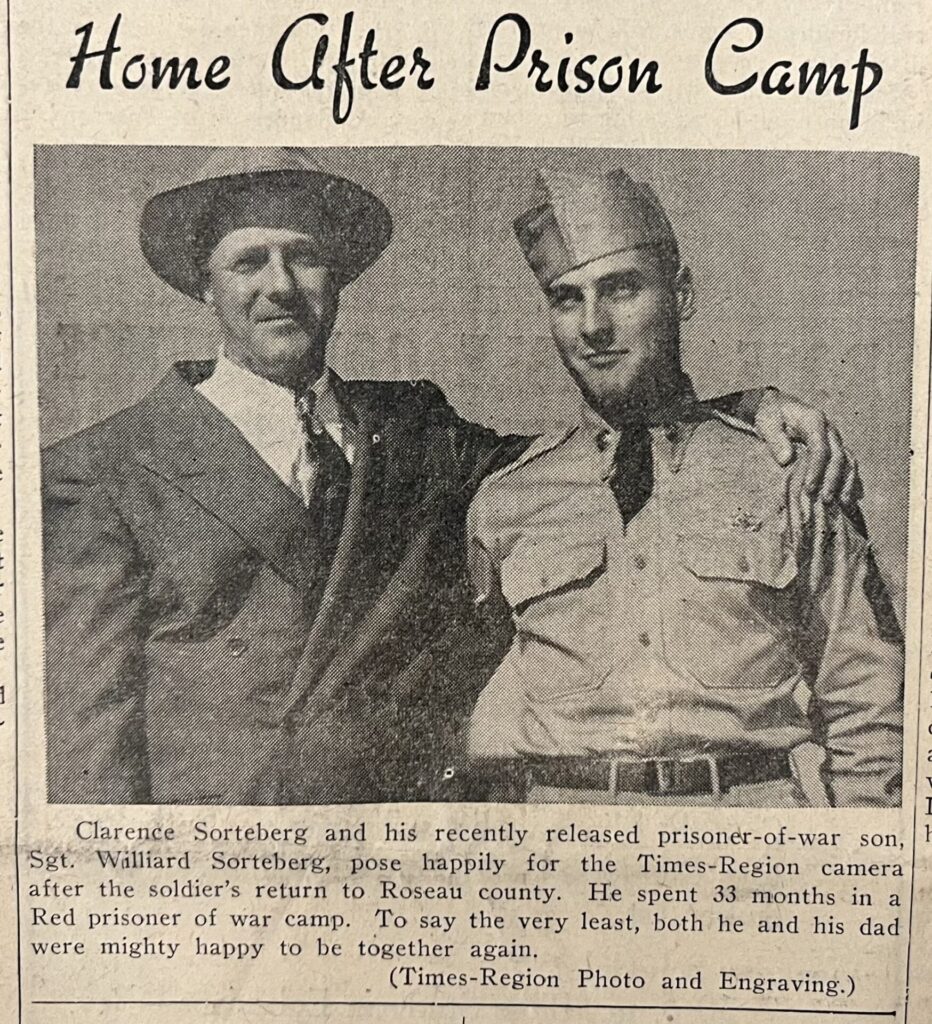
Last week I read from an interview in the Roseau Times-Region in 1953 of a prisoner of war, just
released from Korea and home to Roseau County. His name was Willard Duane Sorteberg. He
had stayed in two camps for most of his time as a prisoner but had just been moved to another
that turned out to be worse. I’ll read the rest of that story today.
Here they had to clean the camp, carry wood for seven miles and sleep 25 strong in small huts to
ward off the 30 below zero weather. “We rolled together on the floor to keep warm . . . but we
couldn’t stretch out, our knees were in our chins all night. We’d just try to sleep a little and wait
for daylight,” he said. The food at this camp was even worse than at the others. They had rice
and some steam bread made of water and rice flour. The only variety they had was soy beans.
While in this camp, Sgt. Sorteberg was a cook. Here he also lay ill of pneumonia from April to
August and fought seizures of malaria . . . with only a little sulfa after four months of no
treatment!
When asked if they had any meat to supplement their diet, he grinned and said, “a few dogs and
cats!” Later, however, things started to go a little better and they had some pork and beef. It was
in this camp he got word of the impending prisoner exchange.
“They told us the day they signed the prisoner release that we would get out. Boy, were we
happy. You sure could hear it when we began to move out!” All he had to pack when the order
came was a single blanket. “And I could barely roll that up,” he said. He was down to a little over
100 pounds in weight.
 When they loaded into trucks and passed the Yalu and pulled into the neutral area, the long spell
of terror and near-death was over. “The Marines put a ladder up to the back of our truck . . . there
were generals and colonels shaking hands . . . ambulances and a field hospital . . . and chaplain
and coffee and milk . . . and newspapers,” he recounted.
After a spell of medical treatment and physical examinations, he was flown to Inchon by
helicopter. Then he was processed and shipped for home. “It had all seemed like a bad dream by
this time,” he said.
His ship docked on September 11, [1953] at Ft. Mason [in San Francisco, California] and he was
home in the USA. “There just isn’t any other place like it,” he said, and his voice rang with
emphasis. When asked if he could ever get along with Communism, he said, “No!” and added
that the Reds didn’t even treat their own troops decently. They were always half starved and
poorly clothed. He felt that a time bomb in the offices of some Communist newspapers in this
country would not be misplaced.
Sgt. Sorteberg has no definite plans for the immediate future. “Rest and relax a little . . . let things
take their own course for a while. Probably get married and settle down,” he said.
Now 33 months of starvation, insistent propaganda, illness and fear are behind him. Now he is
free . . . and best of all, Home. “There just isn’t any other place like it.”
That was the end of the article. I looked up Willard on Ancestry.com and found that he had been
born in rural Portland, North Dakota to Clarence Sorteberg and Nettie Syverson. In the 1940
census, Willard was living with his father and family in Barnett Township in Roseau County. By
the 1950 census, he was counted in Fort Lewis, Washington. This article was published in
October of 1953, and by the next month, Willard had married Lorraine Brovold on November 7 in
Traill County, North Dakota. Willard was an executive vice president in a bank, and at the time of
his death in 1997 he had been divorced from Lorraine, and he died in Mayville, North Dakota, at
age 66. His burial took place at Bruflat Cemetery in Portland, North Dakota.
Thank you to  for letting us share our county’s history with your listeners by donating air time, studio time, and production staff every week.