
These stories can also be heard on Sunday mornings around 10 am on WILD 102’s “Look Back in Time” program. Each week’s radio story will be posted here on our website.
Weekly radio stories are researched, compiled, and read by Sheila Winstead, RCHS Board Member.
September 7, 2025
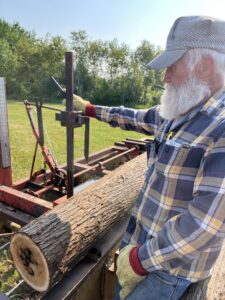
Making a living out of a home sawmill isn’t as common as it used to be, but there are still a few ambitious
people who enjoy it as a hobby, keeping the skills alive with equipment that they’ve kept up through
generations, and other equipment they’ve gathered or made from parts.
I had the opportunity to visit the sawmill of Kerby Eidsmoe and took some pictures, and had a cup of
coffee with his gang of helpers. He had his son, Leif Eidsmoe, there, and Leif’s little pre-school age son
Finn was also there, mostly sitting safely in a boat under a shed, watching a video and enjoying a
doughnut and his puppy, Max. There was also the sawmill cat, Bob, moseying around. Other “hands” on
duty were Lyle Roseen and Randy Cole. Lyle has been logging all his life and Randy worked at Marvin
Lumber with wood products for many years.
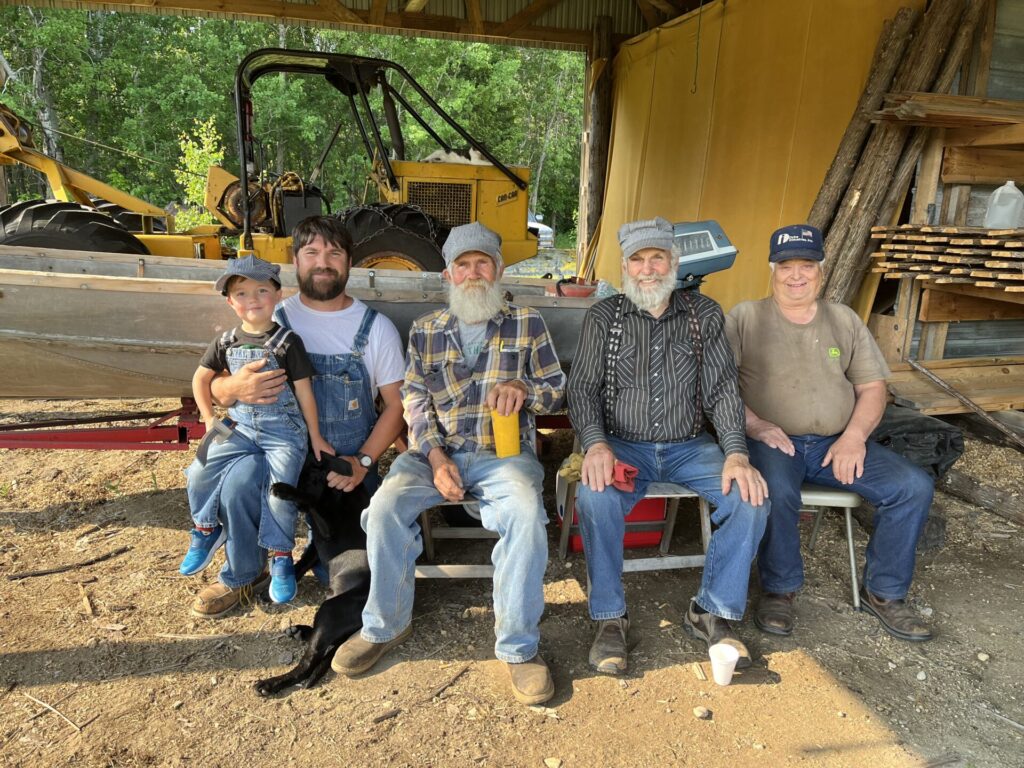
All the men said they have “sawdust in their veins” , having connections with wood from many years of
work. The fun of it is the camaraderie and the love of working with wood. It’s like stepping back in time.
Kerby’s dad, Orlen Eidsmoe, had a sawmill before him, and his Grandpa Almen Eidsmoe operated a
sawmill and was a carpenter. His Grandpa Eidsmoe worked with Kerby’s dad in the woods until the day
before he died in 1966. His other Grandpa, Marshall Wiskow, also operated a bench sawmill, which is
now at the Wiskow Threshing Bee in Strathcona, but it’s considered too dangerous to use. The two
grandfathers were good friends and close neighbors. His dad Orlen operated his sawmill through the
1960s, ‘70s, and into the ‘80s when the recession put an end to it.
When I was there, Kerby showed me some of the parts of the sawmill that he uses. He showed me the
“dog”, which pins the log to the carriage. There’s a lever that adjusts the depth of the cut connected to an
upright ruler, and a marker that moves up and down the ruler as he pulls on the lever. He explained that
the first and last cuts can be measured in even inches, but the ones between must be adjusted by ¼ inch
to allow for the thickness of the huge saw blade. The sawblade has been used by Kerby since 1974. His
dad’s sawmill had a fire in 1973 on a muggy 90-degree day when some sawdust caught fire and couldn’t
be put out. Most of his equipment and blades were destroyed. Kerby’s sawmill is one his dad bought at an
auction after that fire.
I asked Kerby how old he was when he started helping his dad on the sawmill. He didn’t say for sure but
remembers starting out shoveling sawdust and grabbing slabs for the pile to begin with. As he learned the
ropes, he could progress to bigger jobs. He remembers a “dog” injury when his hand got pinned to the
carriage instead of the log. I asked the other guys if they had all their fingers, and they showed me that
they did. Kerby explained that the danger of being hit by pieces of wood usually happens on the back side
of the blade. There was a guard between Kerby and the blade, which appeared to be about 3 feet in
diameter. Another danger is hitting metal in a log. That can ruin equipment and be very dangerous. He
said more injuries happened during logging, though. He had started helping his dad in the woods limbing
trees with an ax. His dad always told him “Never chop wood with a dull ax!”
That day at the sawmill, as the boards were fed onto the carriage by Lyle and Kerby, Randy and Leif were
at the other end carrying off the dimension lumber as it was cut, piling it neatly with spacers between the
layers. There were also strips of bark and slabs to be piled or put on trailers to be hauled away.
Everything is used.
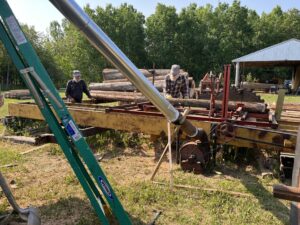
Leif took the “Frankentractor” with a loader and hauled off some of the slabs which had piled up and
moved them to another spot out of the immediate area of the sawmill. Kerby calls his tractor a
Frankentractor because it’s one he made from parts of many other vehicles. He said the original tractor
was one he spotted in someone’s pasture and bought for $200. He used a 2-ton truck axle, and parts of
other equipment to get his tractor into a useable condition.
Kerby also pointed out the ‘edger’, a yellow piece of equipment. He said there’s also a ‘re-saw’ out by the
driveway, which will split 2” pieces into 1” pieces when he has time to work on it to get it moving.
I saw Leif shoveling some of the sawdust that was piling up under the sawblade closer to a hole that
connected to a tube where the sawdust was augered or blown up into a truck box behind the sawmill with
a tarp over the top of it. I could see bits of sawdust filtering out from under the tarp, so I’m sure it was
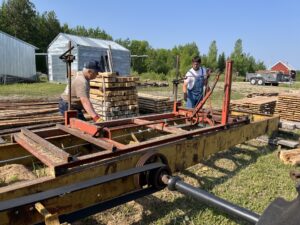
filling up.
Kerby lives in Roseau now. He grew up south of Malung by the Salem Church. His Grandpa Eidsmoe
lived a mile west of Kerby’s folks. His uncle James Eidsmoe bought that farm later. Another connection in
the group of guys is that Randy Cole’s mother is Lyle Roseen’s cousin. It’s that way in these small
communities.
A couple weeks after that visit to the sawmill, my sister Tallie Habstritt and I met Kerby at the Roseau
County Museum and recorded him for about an hour telling many entertaining family stories about the
woodcutting and sawing business, elaborating on some of the details I had gathered earlier. I know he
has many more stories in him, but he had to be somewhere, so we stopped for the day. He said all
sawmill operators share a common love of seeing the best outcome from each log. He also said, “Nothing
smells better than a sawmill in the spring.” After his generation, he knows his son Leif is interested in the
sawmill, and one of his grandsons is, too. Two of his sons work with Hans Grafstrom, a carpenter in
Fargo, so the family interest in wood continues. He laughingly said that even though they go deer hunting,
they spend more time looking around at the trees than the deer.
Kerby is active with the annual Wiskow Threshing Bee in Strathcona, taking care of all the woodworking
equipment there. Cooking is his joy at home, and he now cooks at the Threshing Reunion, too. If you
want a good hearty breakfast, come out there on Saturday morning. The Threshing Bee is always the
second weekend in September, which is the 12 th , 13 th , and 14 th this year. His kids all say it’s their favorite
weekend of the year, and they’ve emphasized making it as kid friendly as possible. You’ll see the results
out there.
Thanks to Kerby for taking time to tell about this fun business. There will be more to tell about the old-
timers, including the women in the family. He had great admiration for them and has a personal goal of
replicating his Grandma Wiskow’s sugar cookie recipe. He said she sent them packed in popcorn in
oatmeal boxes to all the boys she knew in the service.
Thank you to  for letting us share our county’s history with your listeners by donating air time, studio time, and production staff every week.