
These stories can also be heard on Sunday mornings around 10 am on WILD 102’s “Look Back in Time” program. Each week’s radio story will be posted here on our website.
Weekly radio stories are researched, compiled, and read by Sheila Winstead, RCHS Board Member.
December 7, 2025
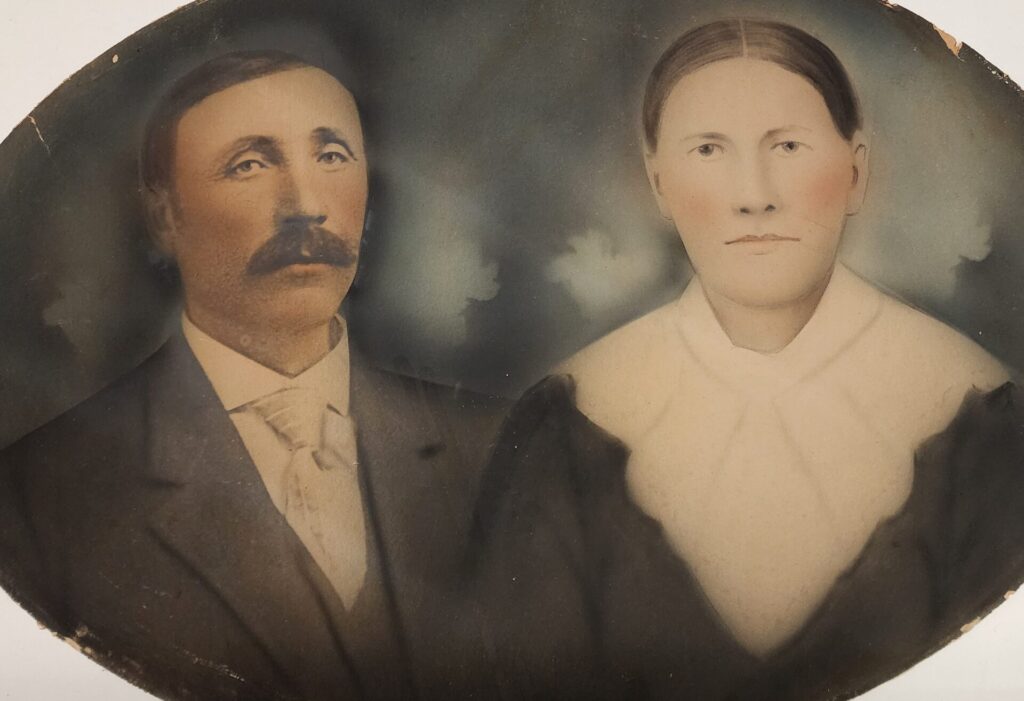
A former Roseau County lady, Joyce Rugland Morken, now lives in California. We’ve become
friends because of her interest in history and Norwegian things and our common community of
Pinecreek. She’s 97 now, but when she was a little girl, she went to school at District 11,
Brookside School, in Pinecreek. Later she attended District 27S near Roseau. Her father died
when she was in 6 th grade, and her mother when she was in 7 th grade. Family members stepped
up and took care of her. She has shared history of her Rugland family, and Dokken family with
me. Recently she shared history of her mother’s ancestors, the Pedersons. They had come from
Hallingdal, Norway, a major valley of eastern Norway known for a vibrant culture, the result of
trading routes which brought in migrants. Hallingdal prospered from iron produced by the
marshlands, and developed its own style of rosemaling and unique Hallingdal Red paint. The
Hardanger fiddle, dating back to 1750, created a distinctive music, and the Halling dance where
each dancer performs on his own to a faster and faster tempo, had the goal being to kick a hat
from the top of a pole which was held higher and higher as the music got faster.
So from that background came Joyce’s grandfather. I’ll read from her story of his life.
My grandfather, Guttorm Person Vedaholet, was born October 13, 1854 on the Vedahole farm
overlooking the valley. As the eldest son, he inherited the farm from his father, Peder. He married
Guri Olsdatter Stolsdokken, born October 17, 1855. Their son, Per, was born September 9,
1879, and a daughter, Bergit, was born September 3, 1882. The farm is in a lovely setting, and
the cattle would be taken up to the summer pastures until September. It was not a big farm, and
times were not easy. The news of free land in America was not easy to ignore, and many began
to think about going. My grandfather had a cousin, John Halverson, who had already gone to
Hatton, ND, and he decided to go there and see if he might immigrate. He joined John in ND and
in April of 1888, they went to the Roseau area to check out the land. Spring had come, the grass
was so green, tall trees for building, and free land for homesteading was available. They each
staked out land to build a cabin, but Guttorm had to move his stake when the surveyer found he
was on John’s land. John is recorded as saying that they “never saw another spring as nice as
that!”
Guttorm went back to Norway for his family. His immigration record shows his Declaration of
Intention dated March 28, 1895, as Gilbert Pederson, that he renounces being a subject to the
King of Norway and Sweden. His wife is Kari Olsdatter, his son, Per (Peder) is 5, his daughter,
Bergit (Betsy) is 3 years old. (It was common practice for immigrants to adopt an American
name.) The farm in Norway now went to his brother, Ivar. After the war, the farm went to Ivar’s
oldest son, Per.
Gilbert first took his family to Hatton, ND. Oscar was born there May 5, 1886. At some time
Gilbert moved his family to Roseau County where Martin was born December 19, 1890. He
settled on a farm north of Roseau. The farm is now a Century Farm, still in the family. Iver was
born August 14, 1894. Anna Matilda, my mother was born March 28, 1896.
This area of Minnesota had so much water, low land, and much flooding in spring. Drainage was
a big problem for many years and required many years of work. Many creeks and rivers crossed
the land. Trees had to be cleared. The heavy soil became gumbo in spring and hard to get
through. It was back breaking work to create a farm. Mosquitoes and bull flies were a constant
problem. A smudge built of a fire-covered with green grass, created a heavy smoke for the
animals to stand in, a relief from mosquitoes. This was not a place for the weak of heart to settle!
Gilbert’s farm was about 3 miles north of Roseau on the road to Canada. Another 7 miles led into
Canada and swamp land before the land became higher. There was lots of wildlife, deer, moose,
bears, and it is still like that. Luckily, Gilbert’s farm was on higher ground and rarely flooded. It
was good fertile farm land. But life wasn’t easy, and the men would finish haying and go to the
Dakotas for the grain harvest to earn enough money to get them through another year. One year
Gilbert and Guri took their children and cattle to Roseau Lake to fish. They caught enough fish to
sell and earned about as much as those who had gone to ND. The language barrier was a
problem, but Gilbert managed to converse with the Indians and they became good friends.
In 1895 Roseau had 700 inhabitants and many improvements. Many people had come from both
Norway and Sweden. Education was important to them. Gilbert was active in many ways in the
community. He helped to establish the school known as 27S. It was about a mile south of his
farm on the way to Roseau. He served on the school board, and my mother and her brothers
went to this school. I have a picture of her about the age 13 taken in the school. This is where I
went to school from 4 th through 8 th grade. It was a very good school.
Church was an important part of life for the Norwegian settlers. One of the first things they did
was to establish a church and a school. The Rose Free Lutheran Church was started on July 16,
1888 and Gilbert and his family were charter members. He served on the committee to select a
site on the sand ridge (higher ground) for a church and a cemetery, out of the flood zone. In 1895
a group met at the Knut Dokken farm to plan Moe Lutheran Church in Roseau. Gilbert was active
in the planning. Moe Lutheran would be in Roseau but they would share the cemetery at Rose.
Many of my relatives, including my parents and brothers, are in this lovely cemetery. “Moe”
referred back to Norway where many members had come from. Gilbert was elected as a 2-year
trustee, and the church was built.
Next week, I’ll finish reading Joyce’s story about her Pederson branch of the family.
Thank you to  for letting us share our county’s history with your listeners by donating air time, studio time, and production staff every week.