
These stories can also be heard on Sunday mornings around 9:00 am on WILD 102’s “Look Back in Time” program. Each week’s radio story will be posted here on our website.
Weekly radio stories are researched, compiled, and read by Sheila Winstead, RCHS Board Member.
July 26, 2026
Planning for the future of the Roseau Lake Bottom northwest of Roseau has been a controversial issue for the past 10 years, but work is being done, nevertheless. At the Roseau Museum, I found a description of the condition of Roseau Lake in the earliest known history of this area, handwritten by John Billberg of Roseau.
Perhaps the first white men to see Roseau Lake were LaVerendrye and his voyageurs in 1733. They came in birchbark canoes, heading west in search of the western sea (the Pacific). As he moved along, he drew the geological features of the land on his map. Traveling downstream on the river, he named it “Riviere Aux Roseau”- River of Rushes. The name remained and in years to come the Lake also was called Roseau.
When settlers first came, Roseau Lake was almost round. Its diameter was about 2 miles. Largely because of the heavy growth of reeds that encircled the lake, it was famous as a waterfowl hunting area. Fish, too, were plentiful but because the lake was shallow, they sometimes froze out in winter.
In summer, two motor launches took Sunday fishing parties from Roseau village to Roseau Lake. Judging from surviving pictures, the catches were phenomenal. Obviously, no limits interfered with fishing pleasure. As to waterfowl, one old timer said “At times the air was so full of birds they almost blotted out the sun.” Another old timer remarked that in winter the lake was an excellent place to hunt wolves because the deep snows were drifted hard and going was good.
From 1850-1853, the Hudson’s Bay Company operated a post at the lake. When this was found to be in United States territory, it was moved to Reed River, in Canada. The trader was often bored in summer. His only relief was to climb on top of the roof. From there he could gaze over the tall reeds that surrounded the lake. The roof top, too, gave him a view of Mud Lake, which was on the south side of the river. It was about 3-1/2 miles long and was shallow enough for a man to cross on horseback.
From my memory of a letter my father (Eddy Billberg) got from the Hudson’s Bay Archives in London, the trading post was located where the Roseau River ran into the lake. My father and J. W. Durham brought Jim Cobenas and an Indian interpreter to try and locate the site. Jim, who once lived in the old Indian village, pointed out the approximate place.
Mrs. S. W. Bennett, Jake Nelson’s daughter, grew up near the Indian village on Roseau Lake. She tells us that she and the Indian girls were good friends. Every spring they went to Mud Lake and hunted muskrats. They got 10 cents apiece for the skins.
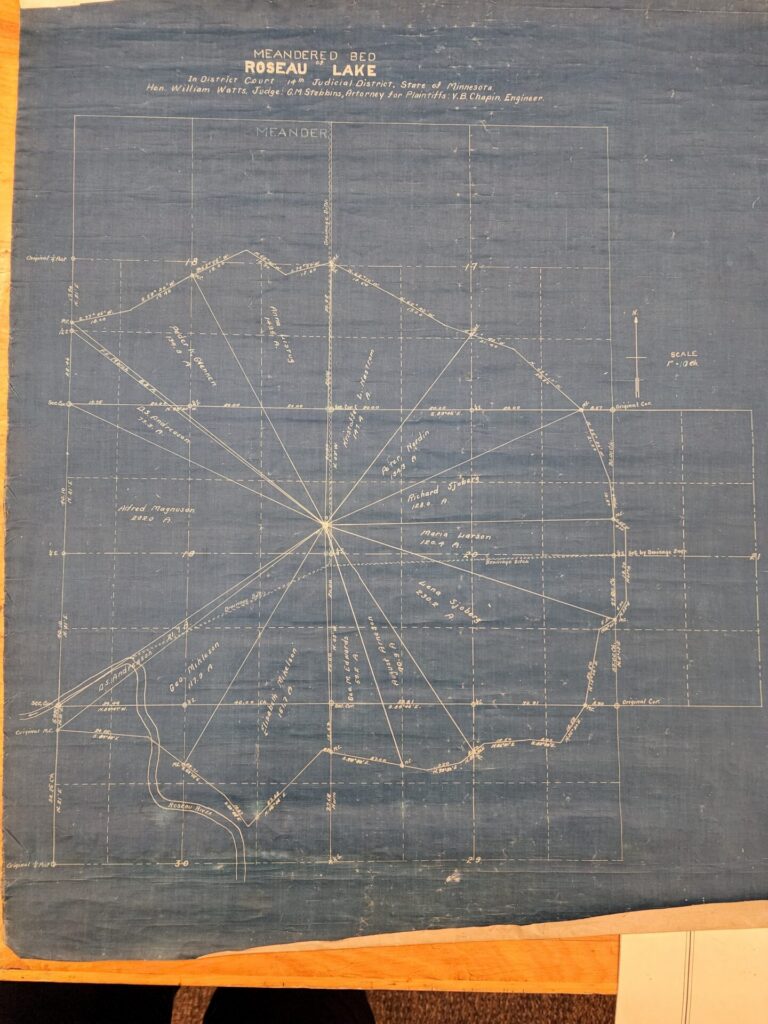 Mud Lake also disappeared when Roseau Lake was drained. The soil in the lake bottoms was rich and black. Reed canary and other grasses grew in fantastic abundance. It proved to be of great value as the farmers now had large herds of livestock.
Most of the hay was cut with horses pulling a mower with a five-foot cutting bar. It was then raked into windrows with a horse-drawn dump rake. After drying, a sweep rake brought the hay to an overhead stacker. This hoisted the loads onto a pile which was then stacked by a man with a pitchfork.
All winter long, farmers hauled hay on horse-drawn sleds with hayracks on them. One day I counted 25 sleds loading in the lake bottom. It was often cold and blustery so horses were blanketed, but the hay moved out every day.
Later, flax replaced some of the hay crop. After the lake dried up in late May, the flax was planted. If the summer was dry, a good crop grew. In years of much rain, the lake filled up, and crops were drowned out. Over the years, there were more dry seasons than wet. Even in times of excessive rains, it took a lot to fill the lake, thus reducing the amount that overran neighboring farm land.
Thank you to  for letting us share our county’s history with your listeners by donating air time, studio time, and production staff every week.