
These stories can also be heard on Sunday mornings around 10 am on WILD 102’s “Look Back in Time” program. Each week’s radio story will be posted here on our website.
Weekly radio stories are researched, compiled, and read by Sheila Winstead, RCHS Board Member.
February 1, 2026
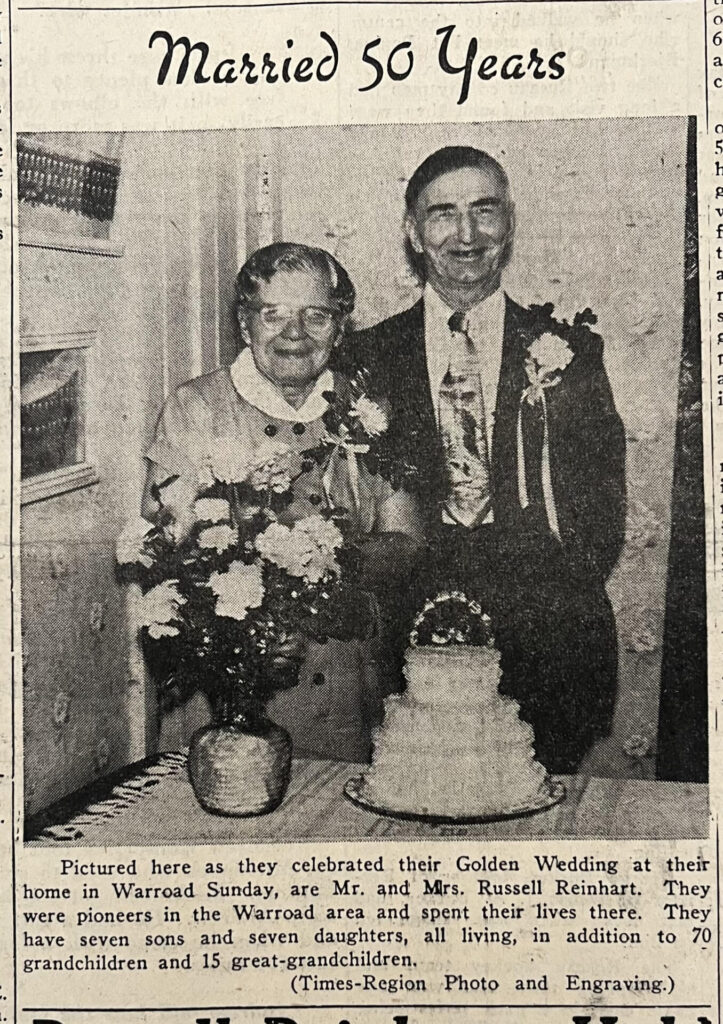
Today I’ll continue the story of Russell and Maude Reinhart of Warroad, a story I found in the
family files at the Roseau County Museum’s research area.
Life during the early nineteen hundreds had its enjoyable, scary and downright dangerous
experiences. The house dances, school socials, picnics and school programs were usually well
attended and fun. If it were too far to walk, too cold, snowy or muddy, those who had horses, a
sleigh or a wagon not only drove to these events, but they offered rides to others. If music was
required at any gathering, it was supplied by local talent. Russell Reinhart was ready and able
with the harmonica, and his brother, Lee could supply the musical chords on the pump organ.
Fiddlers were also available. Sometimes a “musician” would compose a song as he played his
instrument. Who cared as long as the tempo was tolerable? Occasionally a dancer would be
favorably impressed.
“That was a good tune, play it again.”
“Sorry, I’d rather play another one if you don’t mind” was the reply.
There really was not much time for playing around because making a living required most of
each day.
Some pioneers enjoyed fishing, hunting and trapping. They even earned extra money having
fun. Game was plentiful in northern Minnesota, but Russell never shot a deer. He grew his meat
on the farm. He cleared land and raised grain for his livestock. He cut wild meadow hay in the
summer so his horses and cows would have food in the winter.
In the fall he went to North Dakota to work in the harvest fields, not an easy thing to do because
that left Maude and the older children with extra responsibilities. Winters were busy with cutting
firewood for the home fires and also for selling to people in town. Russell and his children also
cut logs and railroad ties to sell.
The homestead buildings sat upon a knoll above the river. A river running through a farm had
advantages. It guaranteed water for livestock in the pasture; it was a good place to swim in
summer and skate in winter; there were fish to be caught in the spring. One disadvantage of
living on a river bank was that the river overflowed its banks during spring thaws or summer
cloud bursts. Sometimes bridges would be washed out making travel across these places
impassable for a time. There were places where roads crossed rivers in places that could be
forded, shallow water and slow water current made that possible. Nearby field crops could be
ruined by floods.
There was much excitement in the spring when fish came up the river to spawn. Not only was it
fun to figure out ways to catch the fish, but it added variety to the food department. They tasted
good fried, smoked, baked and made into patties. Some were preserved in a salt brine in
wooden kegs. One year the fish spoiled and Russell used them for fertilizer in the garden.
Maybe Russell and Maude learned that trick from the Indians who used to come out to the farm
from Warroad. Usually they had a horse and a rig for hauling a few staples back to town. Jim
Cobenas, Tom Lightning, and KaKayGeesick occasionally appeared, to the delight of the
Reinhart children.
One night when KaKayGeesick stayed overnight (he usually liked to sleep on the floor), while
everyone else was sleeping, he was listening to animals digging under the house below where
he lay. He knew what it was when Duffy’s pups started to whine and squeal.
Most log houses built by pioneers had homemade doors of thick boards. If the door latch did not
slip into its slot properly it could swing open. Once while the family was in the hayfield where
Maude was helping stack the hay, the pigs pushed the door open and got into the flour. What a
mess! Another time a sheep buck walked in and scared the children who ran upstairs, all except
the baby who was asleep in the baby buggy between the stove and the wall. Lee didn’t know a
thing about it.
Opening up land for farming was a full time job what with virgin pines to cut and grub out, stones
to pick up and pile. Once the land on the homestead was worked up and planted it raised good
crops. There was a gravel pit on the north field. No one could guess how many yards of gravel
would be taken from it through the years.
After the original homestead house burned down Russell and Lee built a bigger and better
house for a growing family.
There were no schools near enough for the oldest Reinhart children to attend. They stayed with
Grandpa and Grandma Voaklander in Roseau during the school year until a school was built in
their township.
At first there were no churches per se, but circuit pastors held meetings in homes and then in
schoolhouses. As is true now, was true in pioneer days. Some people went to church mostly to
socialize. Once when the singing of a hymn stopped quite suddenly a woman was heard saying,
“I fry my eggs in butter.”
Russell’s formal education stopped at the end of grade four, but nonetheless he was an avid
reader. He read nearly every printed page he could get his hands on. Russell thought he
resembled Abraham Lincoln in looks; perhaps the resemblance was more in the self-education
realm or in being honest in all business and in government business.
Russell and Maude were very independent people. If they could not afford to buy what they
wanted, they would make do with what they had, no charity for them.
The Reinharts lived to experience many changes in lifestyle during their eighty years in northern
Minnesota. The invention of cars led to better roads, better and bigger farm machinery to larger
farms and more leisure time for farmers. They witnessed many inventions that made life very
pleasant. But many of the new ones were not for them.
Russell Wilbur Reinhart died December 20, 1961. Maude Elizabeth Voaklander Reinhart died
September 25, 1963. They were buried in the Riverside Cemetery on the bank of the Warroad
River. They rest in the hope of Jesus’ return to awake them to a great reunion.
Thank you to  for letting us share our county’s history with your listeners by donating air time, studio time, and production staff every week.