
Historic Happenings — Stories from Roseau County’s Past
Discover the people, places, and events that shaped Roseau County through Historic Happenings, the Roseau County Historical Society’s weekly history blog published each Sunday at 10:45 a.m.
These stories also air on WILD 102’s A Look Back in Time, Sunday mornings around 10:05 a.m. Sheila Winstead, RCHS Board Member, researches, compiles, and reads each story, and we publish it here for readers to enjoy and share.
Special thanks to  for generously donating airtime, studio time, and production support to help share Roseau County’s history with the community.
November 8, 2026
94 years ago, a 10-1/2 pound baby boy was born in Malung on December 1st of, 1932, and named Roger Sandstrom. This information comes from a tiny clipping pasted into a scrapbook by Roger’s mother, Esther (Lisell) Sandstrom. I recently met Roger at the Roseau County Museum for an interview, and he let me borrow the scrapbook until our next visit.
Roger was born at home on the same farm he lives on currently. Not many people can say that, especially when you’re about to turn 94. Roger has an excellent memory, and we talked about many things. A local midwife, Mrs. Peterson, attended his birth, and Dr. J. L. Delmore was also there.
Today, in honor of Veterans Day, I’ll concentrate on Roger’s military service in the U S Army.
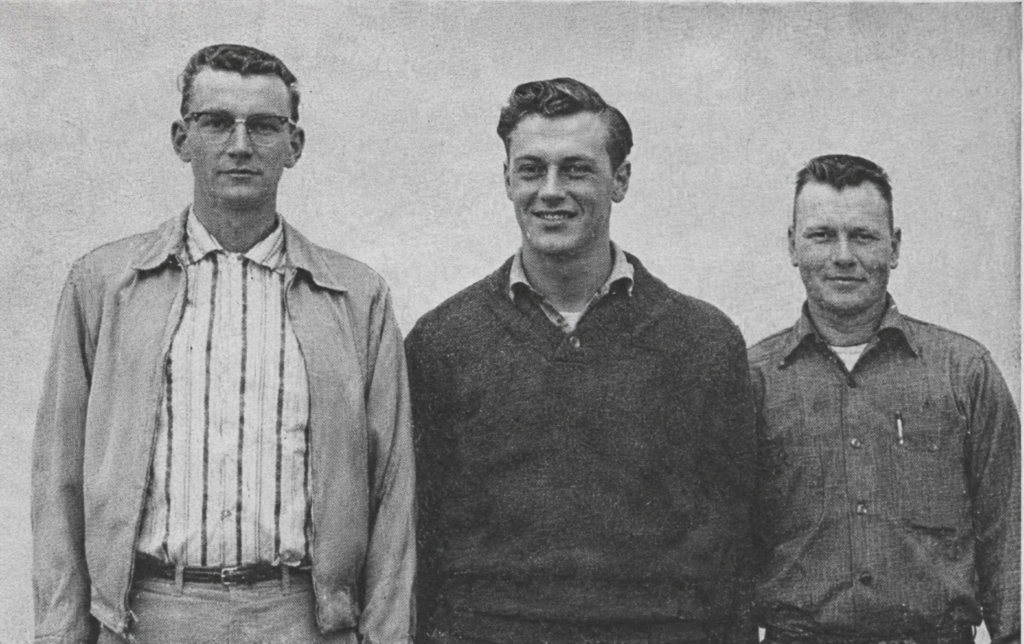
L-R: Roger Sandstrom, Roseau; Jack Comstock, Roseau; Lowell Carlson, Pencer
A photo in the April 18, 1957, Roseau Times-Region shows 3 young men in Roseau ready to leave for service. They’re listed as Roger Sandstrom, Roseau; Jack Comstock, Roseau; and Lowell Carlson, Pencer. Roger looks tall and straight, just like now. Jack ended up being sent to Alaska, but was allowed to come home to Malung for harvest time; Lowell continued going to school stateside for most of his time in the service, and Roger was stationed near Frankfurt, Germany, at Aschaffenburg Army Base. The city of Aschaffenburg itself had a population of about 60,000. Most of the buildings had been rebuilt after the bombings of World War II. He said there was a castle in the town that had been spared from the bombings, which he visited more than once.
His trips to and from Germany were by boat. He said the trip there in the fall of 1957 went well, because the Atlantic is gentler at that time of the year. He traveled there on the USS Patch, a transport ship named for General Alexander M. Patch. His trip back to the USA in April 1959 was aboard the USS Buckner, named for General Simon Buckner. He said that trip in the spring, when the Atlantic is usually rougher, caused a lot of seasickness among the troops. They went through a very bad storm, and many of those on board couldn’t keep their food down. That made it hard for the rest to want to eat, too, so I’m sure they were all glad to see the harbor at home.
Roger had been trained as a mechanic at Fort Chaffee, Arkansas. He said in Germany most of the mechanic work was replacing units, which I had to ask him about. He said they didn’t have time to tinker with repairs on the machinery they had to fix. It was usually faster to replace entire engines or transmissions.
He said their time in Germany wasn’t all work, though. They weren’t at war, except as he jokingly said, “the Battle of the Frauleins”. He didn’t leave base much during his first year in Germany, but by the second year, on his nights off he took advantage of the local clubs where he did a lot of dancing. American music was played in them, and he enjoyed dancing the two-step, waltz, and polka as he did back home. Oktoberfest was a big event there with lots of activities.
He also used his leave time to plan travels to other countries, including Norway, where his Swedish was understood well enough to get along with the locals in Romskogen and Setskogen, about 80 miles north of Oslo, along the Swedish border. He also had the opportunity to go to Italy and the Vatican Square, where he saw the Swiss Guards and the Pope giving his blessing from above the square. He also visited France, Holland, and Belgium while stationed in Germany. On a trip to Italy, he went to Naples and the Isle of Capri, where he took a little boat into the hole in the side of the mountain known as the Blue Grotto because of the way the sea glowed blue inside the grotto. He wanted to see as many places as possible because he didn’t expect to get back to Europe. He took many slides from his adventures there.
After his time in Germany, he was still in the Reserves for four years, two years active, during which he reported to Camp McCoy in Wisconsin for two weeks each year, then two years inactive. He was discharged in April 1963. Roger said this about his time in the service: “I must say my time in the Army was interesting and educational. When I think of the men and women who gave their lives, and some were gone for 2 to 6 years.”
Thanks, Roger, to you and all your fellow veterans for your service to our country.